
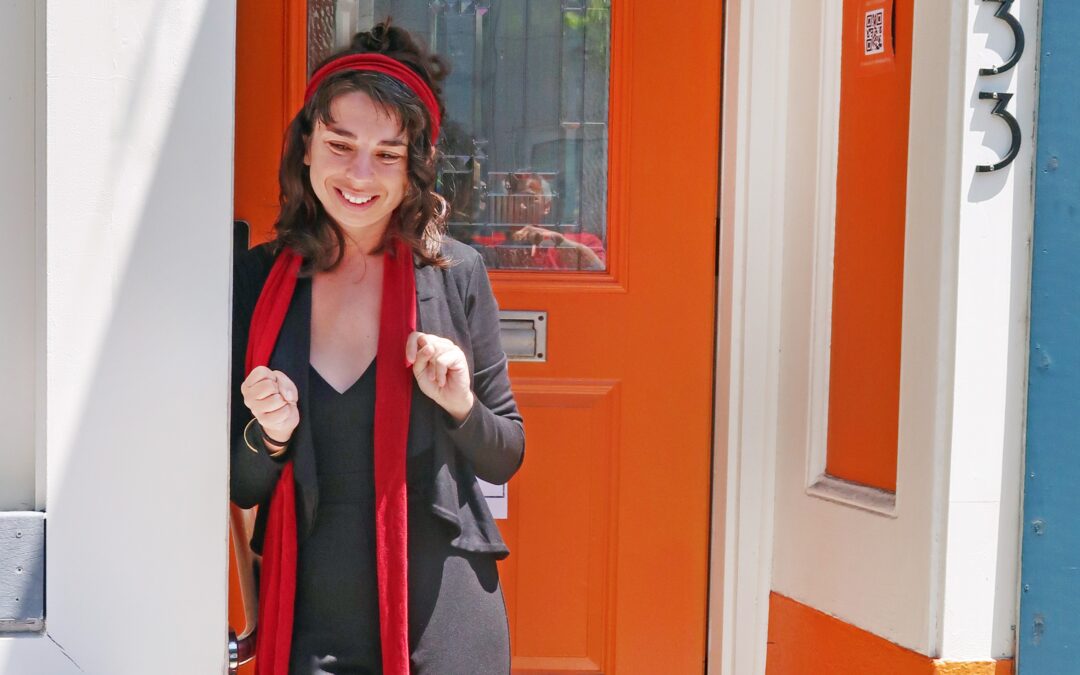
Finding Sacred Space: Rabbi Faryn Borella and Or Shalom’s Vision for Bernal Heights
In the heart of Bernal Heights, a community that values inclusivity and connection, sits Or Shalom, a synagogue with deep roots and a progressive vision. Founded in the late 1980s by three women in interfaith relationships who sought to create a Jewish community that reflected their values, Or Shalom has grown from an after-school program in a living room to a vibrant Reconstructionist synagogue serving the neighborhood and beyond.
Bernal Connect sat down with Rabbi Faryn Borella, the current spiritual leader of Or Shalom, to discuss the synagogue’s history, its place in the Bernal community, and Rabbi Faryn’s journey to the rabbinate. In our conversation, we explored what makes Or Shalom unique – from its early embrace of interfaith families and questioning minds to its musical traditions and progressive values – and learned about exciting developments as the congregation expands into a newly available downstairs space in their building.
Join us as Rabbi Faryn shares insights into Reconstructionist Judaism, the congregation’s vision for its future in Bernal Heights, and upcoming events, including their annual ethics lecture featuring Rabbi Dr. Armin Langer, as well as the joyful celebrations planned for the holiday of Purim.
Let’s start with some of the organization’s history and background.
Or Shalom was founded in the late 1980s and early 1990s, primarily by three women in interfaith relationships. They were exploring the options for Jewish life in the city. They didn’t see themselves reflected in what was available, both in terms of accepting interfaith families, the type of Jewish education they wanted for their kids, and their progressive politics.
It began as a school that offered an after-school program for kids. The framework, which was very different from Jewish education at the time (though not that different from it now), was that the students had to want to go. There was no forced Hebrew school. If you’re in the Jewish community, you understand being forced to go to Hebrew school as a kid. The idea was that no child could be forced to attend school. It had to be voluntary, and it was up to the teachers to create an environment compelling enough for the students to attend.
It began as a Jewish education program for children in Bernal Heights, held in the living room of one of our founding members, just a few blocks from our current building.
Is it in preparation for a Bar Mitzvah or Bat Mitzvah?
I don’t think it was explicitly for that purpose. It was just Jewish education in general. However, the children of our founding members were among the first in the community to receive their Bar and Bat Mitzvahs. I don’t remember the year. Still, the synagogue was formally incorporated in 1991. It had been providing youth education for a couple of years before that.
Or Shalom identifies as a reconstructionist community. What does that mean? Could you explain that?
Reconstructionism is a denomination of Judaism. Like the various strands of Protestantism, Reconstructionism is one of several Jewish movements. Most people are familiar with the main Jewish movements: Reform, Conservative, and Orthodox, although Orthodox encompasses a diverse range of traditions. There are several smaller Jewish movements, including Reconstructionism, which is now known as Reconstructing Judaism. There’s also Jewish Renewal. Those are two smaller denominations within what’s called liberal Judaism, which includes Conservative, Reform, Reconstructionist, and Renewal.
Are there certain tenets that they align with?
Interestingly, in its founding, Or Shalom wasn’t officially part of Jewish Renewal, but its founding Rabbi, Rabbi Pam, was ordained in the Renewal tradition. Jewish Renewal is considered neo-Hasidic – an egalitarian revival of certain Jewish mystical traditions. So Or Shalom has some Jewish Renewal roots and influences as well.
Reconstructionism was introduced by our second-longest-serving Rabbi, Rabbi Katie, who was trained in Reconstructionist thought. She advocated for the synagogue’s formal incorporation as a Reconstructionist congregation. Some of the tenets of Reconstructionism make it a very intellectual tradition. The founder, Rabbi Mordechai Kaplan, had a main tagline: “The past gets a vote, but not a veto.” The idea is that we’re drawing on the deep wellspring of Jewish tradition while creating a Judaism relevant to our contemporary times. We’re drawing upon Jewish wisdom and contemporary insights. We’re carving pathways toward new Judaisms relevant to contemporary audiences, evolving Judaism to be relevant because it’s not useful if it’s not relevant to the Jewish people today.
Where does Kabbalah fit in?
Jewish Renewal is, in some ways, an egalitarian revival of Kabbalah and one of its offshoots, Hasidism. Kabbalah is a mystical tradition that started in medieval times. I remember Madonna going down that path for a few weeks.
Within Judaism, Kabbalah continues to influence Hasidic and Jewish Renewal communities, and it is also integrated into other areas of Jewish life. It was considered very radical in its time and not accepted by the mainstream, but today, many practices across all Jewish communities incorporate Kabbalistic thought.
For example, we recently observed Tu B’Shvat. One of the core practices for that holiday, a new year for the trees, is a Seder based on mystical wisdom created by the Kabbalists. This Seder shares similarities with a traditional Passover Seder but also has distinct differences. This tradition originated in medieval times and was once performed exclusively by Kabbalists. Still, it has become universalized, and many people across different Jewish traditions observe a Tu B’Shvat Seder.
And it’s primarily for welcoming spring.
Yes, it’s the idea that it’s the time of year, at least in biblical Israel, when the sap would start rising in the trees. It’s that transition point between winter and spring, a time to honor and mark the change.
Tell us a little bit about yourself. How did you end up being a rabbi? What’s your journey?
I’m originally from a small town in southern Vermont. I’m the result of an interfaith marriage. My mom is Jewish, my dad is not Jewish and never converted, but I was raised Jewish at this small-town synagogue in Vermont.
If your mother’s Jewish, you can be too, right?
Yes, that’s the traditional view. In our denomination, Reconstructionism, as long as any parent is Jewish, you’re considered Jewish. However, traditionally, it has been passed down through the maternal line, and in certain denominations – such as Conservative and Orthodox – it remains that way.
Growing up in a primarily Protestant area, it was unique to be Jewish, and I valued that upbringing. It wasn’t religious, but it was very communal. I loved the music, the services, and the community. I never thought I would become a rabbi, but looking back, you can see signs of it.
One of the primary rabbis I had until I was 11 was involved in peace work in Israel and Palestine. He fostered my interest in this work, which I pursued in college and afterward. Ultimately, that work led me to the rabbinate.
And then, what is the process of becoming a rabbi?
In liberal denominations, the path often leads to a rabbinical school, similar to a seminary. It’s usually a five – to six-year program. I attended the Reconstructionist Rabbinical College, located outside of Philadelphia, Pennsylvania. I did it somewhat hodgepodge – I spent two and a half years at the Graduate Theological Union in Berkeley, followed by four years at the Reconstructionist Rabbinical College.
How does one get picked for the community? Do you seek out the community? How did you end up in Bernal Heights? In some Christian denominations, it’s more than what you’re assigned, like if I’m thinking of priests.
It’s not like that at all for rabbis. It’s volitional. In your last year of school, they do a lot of work supporting you in finding job opportunities and guiding you through the application process. There are specific aspects to applying for jobs in congregational work, especially. Still, you choose which roles you want to apply for, and the interview and review process is standard, as with any other job.
With congregational positions, the final candidates, usually two or three, are invited for a weekend. You lead services, teach classes, and meet the community. Then, candidates decide whether they like the community, and communities decide whether they like the candidate. Ultimately, they will choose their next Rabbi.
What is unique about the community in Bernal versus other communities?
I think there’s a lot of overlap between what we offer and other synagogues in San Francisco, and there are also things that make us unique. From what I’ve heard from founding and longtime members, a key historical distinction is that we were among the earliest to accept interfaith families. We have had non-Jews in leadership, including the board president, which was especially rare at the time. Some of these things are becoming more common in certain spheres, but there were many ways in which Or Shalom was ahead of its time.
Another distinction is that it has always been acceptable to question the existence of God at Or Shalom, which wasn’t necessarily welcomed in other communities. We have a group called the Considering God Salon for atheists, agnostics, questioners, or God-curious people – anyone who doesn’t want to accept things at face value. They meet four times a year to discuss different topics and create space for being Jewish without requiring any specific relationship with the divine.
We’ve always been a very musical community, which isn’t unique, but it’s what sets us apart.
Many of our founders were part of the anti-war movement of the 1960s. Many hippies, leftists, and progressives founded the community, instilling values that continue to distinguish us in San Francisco.
Or Shalom is queer-friendly, correct?
It’s almost like it’s not even a question for us. One of the beautiful things about Judaism is that, at this point, there are so many different forms of liberal Judaism. I sometimes forget that “religion is oppressive to queer folks” is still a perception.
Of course, inevitably, even for people attempting not to engage in homophobia, it’s like the air that we breathe. So, our community could unintentionally contribute to that culture. But Or Shalom in no way says, “Our religion teaches us that queerness is bad or transness is bad.” Rather, it’s very much about looking at the ways the Torah endorses and celebrates queerness and transness, knowing that it can and does get interpreted in other ways. The Torah is an expansive enough founding document that you can find both liberatory and oppressive approaches to gender and sexuality.
You must be in the midst of a transition, as I’ve seen the space downstairs open up. Could you tell me a little about the transition, what’s happening, and what we can expect in the new space?
It’s been a very slow-moving process. We had long-term tenants downstairs, and when the building was purchased (before my time), the tenants agreed to vacate in a couple of years. We gained access to the upstairs area earlier, but we had to go through the planning commission process to obtain a conditional use permit. It was zoned residential but hadn’t been used as a residence for many years.
Now that the downstairs space is also available, we’ve engaged a team of architects to guide us through a controlled planning process, designing it to best serve as a sacred space for our community.
What does that mean regarding the expansion of what you’ll be offering?
We’re running into the fact that we’re growing, and the space is a certain size. The hope is that it can serve as a sanctuary, a social gathering space, and an educational space, catering to both adults and children. When not in use, we can rent it out to community members for events, thereby making it a valuable resource for the community.
It’s a multi-use space, but we acknowledge its limitations. Some programs operate from the building, while larger programs require renting space elsewhere.
As we progress, we can move more programs in-house, acknowledging that some of our larger programs will never fit into this building.
Do you partner with other Jewish organizations for those events?
We primarily rent space from churches. We hold our holidays at the Unitarian Universalist Church, run Shabbat services at Noe Valley Ministry, and use St. Aidan’s. For the bigger events, we rent space between these three locations.
That leads to how interfaith communities interact in San Francisco and how you’re part of that.
We’re trying. We aim to establish a strong coalition of solidarity with other religious organizations in Bernal Heights. We’ve already collaborated on programming with the Islamic Center and hope to do more, including partnering with churches, though we haven’t done so yet.
We are also part of Faith in Action, which works across San Francisco and the Bay Area. While different faith communities and individuals primarily support refugees and immigrants, we’re also engaging in interfaith efforts in other ways.
How do you balance the traditional Jewish practices with today’s world?
That is the motto of Mordechai Kaplan and Reconstructionist Judaism. His idea is that the world is constantly evolving, and Judaism has evolved in tandem with the times. Much of our education as Reconstructionist rabbis explores the notion that there has never been a singular, unified concept of “traditional Judaism.” Judaism has evolved significantly over time and across various regions, influenced by surrounding cultures.
When we change, that’s the most Jewish thing we can do. Modernity has imposed traditionalism, but change has been the core experience of Judaism over time. Judaism, a land-based, place-specific tradition, has endured for thousands of years by adapting and evolving to function effectively across diverse geographic locations and historical periods under various leadership and religious regimes.
As Mordechai Kaplan put it, the core practice of Judaism is to find a way to keep practicing our tradition in a way that is relevant to us as modern individuals. Judaism has so much to offer, but only if we view it as more than just a relic of the past. We’re using tradition to form how we relate to our world today.
How do you interact with the Bernal community at large
I think we’re still growing and building those connections. We’re fortunate to have many members living in Bernal, a desirable neighborhood. We’ve heard from many unaffiliated Jews in the neighborhood that they’re excited we’ve moved here and that, because we’re here, they might affiliate for the first time. They’re also excited to have a Jewish resource in the neighborhood.
Even though we’re not a business, we’re part of the Bernal Business Alliance because building those connections is important. We’ve participated in various holiday strolls, movie nights, and the pet parade – we’ve been trying to engage with neighborhood events. And even with all that, some still say, “Wait, what? There’s a synagogue here?”
You’re upstairs, so there’s no street-facing presence. That may change when you open up downstairs.
Exactly. We’ve started running some programs downstairs, but it’s unclear what they are yet, since the walls are bare – it’s very bare-bones. It’s funny because there are those big windows, and we watch people walk by as we’re doing a program, looking in and trying to figure out who we are. The sign still reads ‘We’re a Pickle Shop.’
What are some of the upcoming holidays and events that you’re focused on?
This weekend, we are bringing a scholar-in-residence to town. His name is Rabbi Dr. Armin Langer. He is both a rabbi and a professor. He’ll speak at our Friday night Shabbat services, but the big event is on Sunday. It’s our second annual ethics lecture. He’s our ethics scholar-in-residence and will speak on Jewish approaches to immigration and refugee issues this Sunday at 10 a.m. at the JCC.
Very topical.
Exactly. The way these ethics lectures were designed – they were endowed by one of our members, Stephen Gerard, in honor of his parents – is that they are a free resource open to the entire San Francisco Jewish community and beyond. If people want to come, they are welcome. It uses Jewish frameworks but is free and open to the public. It’s not just for the Or Shalom community; it’s open to the wider community, and we encourage anyone who wants to attend. You can find more information on the website, including the lecture title and other details.
The next holiday is Purim, which is on March 13th. We will hold two programs, one in Noe Valley at Noe Valley Ministry and one in Bernal.
Purim is often likened to Jewish Halloween. It’s a holiday where you’re supposed to dress up in costumes. The idea is that everything is turned on its head. It’s centered on a story written as a political satire about Jews facing persecution and their response. It’s a carnivalesque holiday where you’re supposed to get weird and silly – everything gets turned upside down, extreme, animated, and playful.
It’s a complicated, fun, and complex holiday, especially in these challenging times. We will be hosting a large Purim party at Noe Valley Ministry on Thursday night. One of the practices of Purim is the Purim Spiel, a silly play.
The following Sunday, we’re awaiting confirmation from the city that it’ll be our second annual Purim Carnival at the Bernal Heights Rec Center Playground. We also did it last year, featuring carnival games for kids, including a ring toss, a spin-the-wheel game, and a costume parade up and down Cortland Avenue. That event is more targeted towards young families.
Is there anything else you would like to add?
There has been such a warm reception in the neighborhood. It’s a wonderful neighborhood; we feel like we’re part of a community, not just on a random street. We love to meet new people. One of my favorite things has been being at Progressive Grounds or walking down the street and people saying, “Oh, you’re the rabbi,” or running into congregants or people who’ve been to services, or people just knocking on our door saying, “I see you’re a synagogue, I would love to talk.”
Those encounters on the streets, as well as in Bernal’s restaurants and coffee shops, are some of the sweetest parts. If you’re curious about us, please don’t hesitate to stop by.
Change as Tradition: Or Shalom’s Reconstructionist Approach
Calendar – Bernal Heights and Beyond
Or Shalom Jewish Community | Progressive Reconstructionist Synagogue in Bernal Heights

Mike Doherty serves as Chief Experience Officer at Greening Projects, a nonprofit organization dedicated to transforming underutilized urban spaces into vibrant green areas

Great presentation of OS , our history and present
Thank you
A wonderful historical and cultural reflection of Or Shalom and our values and offerings. Having Rabbi Faryn as our Rabbinical leader is a gift and is attracting new younger and older folks. An additional unique aspect of OS is that we have had women rabbis for almost all of our 35+ years.