
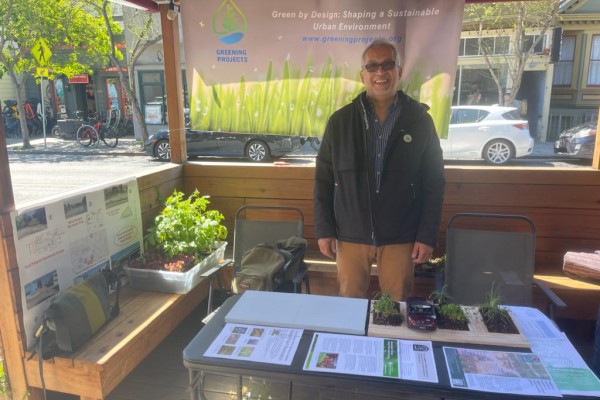
Greening Bernal One Project at a Time
Recently, I sat down with Jorge Romero-Lozano. He is currently undertaking several Greening Projects around Bernal Heights and beyond.
How long have you been a resident of Bernal?
What inspired you to launch Greening Projects?
How do you engage with the community to ensure that the green spaces you create meet their needs and expectations?
I garner buy-in from at least the neighboring property owners, a requirement also shared by local public agencies and grant administrators. Then I try to ensure that we engage as many people as possible, especially underserved communities, who often do not speak English and do not understand processes such as providing their input, the permitting and hearing process, and how design and construction work.
Can you tell us about some of your projects?
- We are shutting down the 400 block of Ogden Avenue, between Folsom and Gates Streets, to through traffic and turning the area into a park.
- We are expanding the Good Prospect Community Garden, located on Prospect Street between Cortland and Santa Marina, by adding more garden plots and improving the site with additional landscaping and a gathering area.
- The vacant lot on César Chávez Street, next to the 101 southbound ramps, will be transformed into a bicycle way station and a site to honor the memory and legacy of César Chávez.
- We are collaborating with the Carolina Street Median project to enhance landscaping and create a vista point at the median’s south end.
How do you measure the success of a green project beyond the completion of the physical space?
How do you incorporate sustainability into your green projects in the construction process and ongoing maintenance?
- It starts with design, for example:
- Minimizing grading to the extent possible, without disrupting the existing topography.
- Designing bio swales, which collect runoff and return it to the groundwater supply
- Specifying sustainable materials such as porous cement, which allows water to seep back into the ground; recyclable and/or repurposed materials, such as fallen tree trunks to make benches; and repurposing demolished materials, such as concrete, which can be used as base material or to line swales.
- Rainwater harvesting involves capturing rainwater for irrigation.
- During construction, we ensure:
- Dust control and pollution are minimized.
- Controlling waste management and recycling
- Limiting materials used to reduce waste
How do you ensure that the green spaces you create have a positive impact on the environment and contribute to mitigating the effects of climate change?
- Stormwater runoff is used for irrigation through rainwater harvesting
- Stormwater runoff is captured in bioswales, reducing the amount that flows into the combined sewer system.
- More trees and plants increase the tree canopy, improving health and serving as a screen.
- They reduce the heat island effect caused by hardscape materials, such as concrete and asphalt pavement.
- By volunteering to help in the design and/or maintenance of the new green spaces
- By donating to their favorite green project to buy plants, playground equipment, benches, etc.
Where can we learn more about Greening Projects?
The Joy of Green Space Volunteering

Mike Doherty serves as Chief Experience Officer at Greening Projects, a nonprofit organization dedicated to transforming underutilized urban spaces into vibrant green areas
