
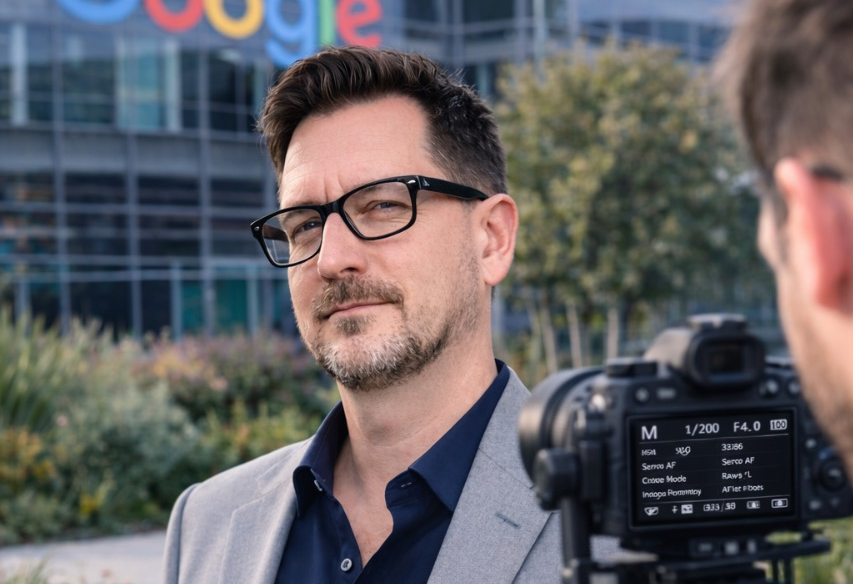
From BART to Bots: How a Bay Area Engineer Is Bringing AI to Bernal’s Small Businesses
Andrew McCulloch spent two decades moving people through some of San Francisco’s most complex spaces. Now he’s helping local business owners move through their workdays a little faster.
When Andrew McCulloch arrived in San Francisco from Nuneaton, England, in 2001, he came as a transportation engineer, someone whose job was to figure out how thousands of people could move through a building efficiently without chaos. Over the next two decades, he applied that thinking to some of the Bay Area’s most ambitious projects: the Salesforce Transit Center, BART, Apple Park, and several Google campuses.
In 2010, he put down roots in Bernal Heights. And somewhere along the way, he started noticing that the same systems thinking he applied to transit terminals applied equally well to a neighborhood hair salon struggling with cancellations, or a small business drowning in paperwork.
Today, through his company KCHN Enterprises, McCulloch offers something that most Bernal and Mission business owners haven’t had easy access to: practical, no-jargon guidance on how AI can take over the parts of running a business that nobody actually wants to do.
When asked about the business name, he noted that KCHN was quite literally born in his kitchen. “When it came time to name the company,” he shared, “I took ‘Kitchen,’ stripped out the letters that weren’t pulling their weight, and landed on KCHN. It still reads as ‘Kitchen’ if you squint.”
Ultimately, the name stuck because “removing everything that isn’t doing useful work” proved to be a perfect metaphor for the business itself, streamlining operations and eliminating friction for every client.
The problem isn’t AI. It’s the translation layer.
Ask most small business owners what they think of AI, and you’ll hear a mixture of curiosity and overwhelm. The technology is everywhere in the news, but the gap between “AI is transforming industries” and “AI can help me stop manually calling clients when someone cancels their 2 pm appointment” is enormous, and largely unbridged.
That’s the gap McCulloch has positioned himself to fill.
“Most solutions don’t address practical needs,” he explained. “They don’t connect with existing systems. A business owner doesn’t need a chatbot. They need their Tuesday afternoon to stop disappearing into tasks that shouldn’t require a human at all.”
His approach starts with a free 30-minute consultation, no pitch, no pressure, focused entirely on understanding where a business is losing time. The target audience is modest-sized operations: businesses with 5 to 30 employees that are large enough to have real administrative overhead but small enough that every hour matters.
What automation actually looks like at street level
McCulloch’s go-to example is a salon. When a client cancels at the last minute, the typical response is for a staff member to manually work through a waitlist, making calls, sending texts, and waiting for replies. It’s time-consuming, interrupts other work, and often still results in an empty chair.
An automated system handles this entirely without staff involvement: it detects the cancellation, reaches out to the waitlist in order, confirms a replacement, and updates the calendar. The human role becomes simply approving the outcome.
This pattern: automation handles the routine; humans handle the judgment. Repeats across industries. For a healthcare practice, it might mean an intake process that collects patient information and organizes it before anyone sits down to fill out a form. For a bookkeeper or accountant, it might mean automated data collection that surfaces key performance indicators rather than raw numbers.
“The goal isn’t to replace people,” McCulloch said. “It’s to stop spending their time on things that don’t need them.”
He estimates that for businesses that spend significant time on routine administrative work, existing systems can already automate around 95% of those repetitive tasks — using tools many businesses already pay for but underutilize.
Bernal as a test case for something bigger
What makes McCulloch’s project interesting is as much about place as it is about technology. Bernal Heights has a deeply hyperlocal character; residents tend to stay close to home, the hill divides the neighborhood into distinct micro-communities, and the Cortland and Mission corridors each have their own flavor and regulars. It’s not a neighborhood that responds well to generic outreach.
He has been getting to know it the old-fashioned way: on foot. Using a walking app, he’s been systematically covering Bernal’s streets, logging every block, currently somewhere around 30% of the total. It’s a quirky personal project, but it speaks to something genuine about his orientation toward the neighborhood.
McCulloch will bring his message directly to that community at the July meeting of the Bernal Business Artists Alliance, which has recently opened membership beyond artists to the broader business community. His goal is straightforward: demystify AI enough that a florist or a physiotherapist can walk out of the room with a concrete idea of what it might do for them.
The engineer’s instinct
There’s something fitting about a transportation engineer becoming an AI adoption guide for small businesses. Both roles are fundamentally about flow, identifying where things get stuck, where time and energy are wasted, and designing systems that let the important stuff move through more easily.
McCulloch’s 20 years of Bay Area infrastructure work gave him a particular way of seeing problems: not as isolated technical challenges, but as systems that affect the people inside them. A transit center that works beautifully on paper but frustrates commuters in practice is a failure. An AI tool that sounds impressive but doesn’t fit into how a business actually runs is the same kind of failure.
The fix, in both cases, starts with understanding how people actually move through their days.
Andrew McCulloch is available for free 30-minute AI and automation consultations for businesses in Bernal Heights and the Mission.
Learn more at kchn-enterprises.com.
KCHN Enterprises AI Automation and Creative Production
Bernal Heights Neighborhood News

Mike Doherty serves as Chief Experience Officer at Greening Projects, a nonprofit organization dedicated to transforming underutilized urban spaces into vibrant green areas
